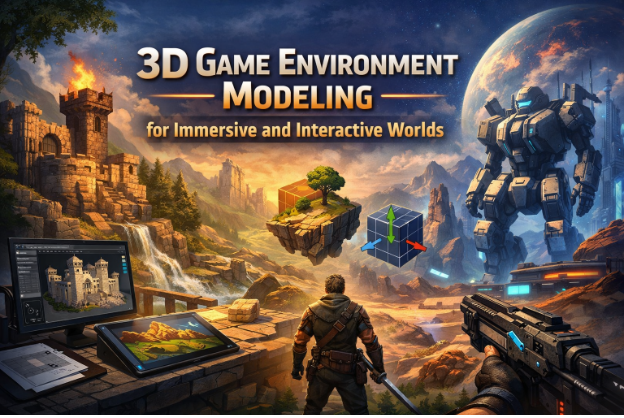

In modern games, an environment is no longer just a background-it is a living space that dictates the way games are played, stories are told, and players feel. From expansive open worlds to tightly designed interiors, the quality of an environment directly impacts how immersive and interactive a game can truly be.
It is in this place that 3D game environment modeling plays a huge role, where concepts are transformed into explorable and believable worlds, crafted for real-time performance.
As the amount of detail expected by players increases, environment modeling has developed into a complex art that is a combination of art, design, and technical optimization.
What is 3D Game Environment Modeling?
3D game environment modeling consists of creating all the visible data that constitutes a world of any game. This includes: lands, buildings, interiors, props, terrain, and background elements with which the player would either interact or travel across.
The aim is not just to enhance the appearance of an environment but to make it:
- Support Game Mechanics
- Guide players’ movement and exploration
- Reinforce narrative and atmosphere
- Perform smoothly in real-time engines
A well-modeled environment feels cohesive, readable, and responsive to player actions.
Building Immersion with Visual Storytelling
Great game environments tell stories without words. A cracked wall, abandoned machinery, or a few carefully placed props can convey in an instant whether this is a place with history, danger, or comfort.
Artists, through 3D game environment modeling, make use of:
- Architectural styles and layouts
- Environmental wear and decay
- Light and color composition
- Foliage, terrain, and other natural features
These visual hints allow players to intuitively understand the world and stay emotionally attached to it.
Interactivity: Designing Spaces for Gameplay
But immersion alone isn’t enough: the environments must also be interactive. Every space has to support gameplay flow, player navigation, and interaction systems.
Environment modeling considers:
- Passways and points of interest
- Cover placement for combat situations
- Verticality for exploration and strategy
- Interactive objects and destructible elements
By aligning the design of an environment with gameplay needs, worlds feel intentional rather than decorative.
The Environment Modeling Pipeline
1. Concept and World Planning
It starts by creating concept art and the level design plans. In this stage, the mood and scale of the environment are defined, as well as the structure with gameplay requirements.
2. Blockout and Layout
Artists create simple blockout models that have established proportions, navigation paths, and spatial flow. At this stage, gameplay testing is in focus rather than visual detail.
3. Creation of Assets
Once the layouts are approved, individual assets will be built: buildings, terrain elements, props, and modular pieces that can be reused across levels.
4. Texturing and Material Setup
Materials are defined in PBR workflows so that surfaces react to lighting in a realistic way: terrain textures, architectural materials, and environmental props.
5. Light and Mood
The lighting is huge for immersion. The balance between natural and artificial light, fog, shadows, and color grading all serve to define the mood and direct the attention of players.
6. Optimization and Engine Integration
Assets are optimized for real-time performance by using LODs, texture atlases, and efficient geometry. Everything is tested in-game for smooth gameplay.
Modular Design for Scalable Worlds
Many modern games depend on modular environment assets. Rather than creating everything from scratch, artists make reusable components that can be assembled in a variety of ways.
Benefits of modular environment modeling include the following:
- Faster world-building
- Well-set visual language
- Easier updates and expansions
- Optimized performance
The importance of this approach, however, gives environments time to evolve, especially in open-world and live-service games.
Performance Optimization Without Loss of Detail
Game environments often have thousands of onscreen assets at any given time. Without optimization, even the most beautifully designed world can experience performance issues.
These are some of the key optimization techniques:
- Level of Detail (LOD) systems
- Occlusion culling
- Texture streaming
- Efficient usage of UV and material
It is a core skill in 3D game environment modeling to always balance detail with performance, never breaking a player’s immersion due to technical limitations.
Why Studios Outsource Environmental Art
Environment production in a game is asset-heavy and time-consuming. Scaling that content up while meeting deadlines can be quite difficult, so many developers use 3D game art outsourcing services.
Outsourcing teams help by:
- Large volume creation of environment assets efficiently
- Adhering to established traditional art styles and technical guidelines
- Supporting open-world or multi-level projects
- Allowing internal teams to focus on design and gameplay
Outsourcing, now with clear pipelines and communication, becomes a strong extension of the internal art team.
Consistency in Game World
Creating an environment comes with one of the biggest challenges: consistency across large maps and multiple levels.
Structured workflows guarantee that:
- Unified scale and proportions
- Consistent material behavior
- Unified architectural and environmental style
The Impact on Player Experience
Players might not consciously consider environmental assets, but they get that something is off when a world is poorly constructed. Frictionless navigation, believable spaces, and interactive elements will all improve engagement and retention.
Strong 3D modeling of game environments:
- Encourages exploration
- Improves narration
- Gameplay clarity supported
- Increases replay value
It revolutionizes environments from static backgrounds into dynamic actors in the overall game experience.
Conclusion
The basics of modern gaming are immersive and interactive worlds; 3D game environment modeling brings those worlds into being. Artists merge artistic vision, gameplay-driven design, and real-time optimization to carve out spaces players don’t just see but experience.
The studios can only scale up the production of environments consistently with the help of professional 3D Game Art outsourcing services. In today’s competitive market, well-crafted environments are no longer optional but an integral part of building truly memorable, engaging, and immersive worlds of games.